Pages

Saturday, 19 November 2016

FREEING UP RURAL COMMUNITIES ON WHEELS

By the year 2030, it is forecast, fewer of us will be driving cars. On some roads human-driving will be prohibited. We will dial up a car. It will arrive at our front door and it will transport us to our chosen destination. The "smart car" will do the driving. Sound fantastic? Some self-driving cars are already being tested on our roads. Autonomous, self-driving vehicles are just a few years away from mass production.


Uber already transports people in self-driving vehicles in trials in Pittsburgh PA. Since Walmart is working with Uber and Lyft to deliver it makes sense that Walmart closely eyes the self-driving vehicle business -- as would Walmart's greatest competitor Amazon.com. San Francisco-based Otto delivered 50,000 beers almost 200 km in Colorado, about a month ago. In Singapore you can catch a ride in a self-driving taxi using your smartphone. Canadian Business reports that every business will be affected by self-driving cars.

What will autonomous vehicles mean for creative rural communities?

The Victoria Transport Policy Institute in Victoria, British Columbia, reports that conventional public transit will change. Self-driving vehicles will provide mobility for non-drivers [and isolated citizens]. The report also states that job losses could occur by requiring fewer drivers and lowering/eliminating vehicle maintenance and repairs. The reports also outlines risks. VTPI predicts autonomous vehicles "will have little effect in exurban and rural areas, though they do point out the benefits of car-sharing.

I sense that rural citizens will have increased access to medical, education, social and food services, support, supply and facilities. Isolation will be lessened. In some cases citizens will never need to learn to drive. The world will come to our doorsteps. How liberating would THAT be?


[Question ... if an autonomous vehicle is pulled over for a traffic violation/issue, and there is no driver, to whom will the police officer issue the ticket? ... and will "road rage" disappear?]

Monday, 7 July 2014

CULTURAL CROSS-COLLABORATION: FOOD, MUSIC, FILM, MUSEUMS, POETRY, PAINTING

The role of food in the creative economy has been posted a number of times in this blog. Over the past year I have been observing the creative food events from Scandinavian countries and have enjoyed observing the mix between food and other creative sectors.

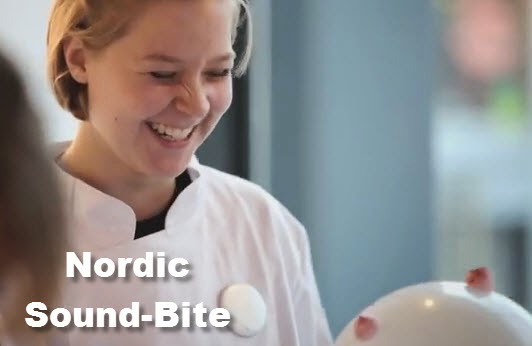
Nordic Food introduced "The Nordic Sound Bite" at the Ja Ja Ja Festival in London, UK, November 2013 -- a two day celebration of Nordic music, film and food.
The Nordic Sound Bite is a mix of music and food; a collaboration between food artists and musicians. Food artists designed, prepared and delivered special "sound-bites" representing "20 seconds of the DNA sound" from five of the music bands playing at the Ja Ja Ja festival (Mew, NONONO, Sin Fang, Sakaris and Astra Kid). The "Morning Sound Bite", for example, were Nordic sweets stuck to a balloon. Organizers see a future in providing sound bites at events either as a warm up or as an extra level of consciousness when you listen to the music.

In 2012 the New Nordic Food II Scandinavian programme started an unlikely project to mix food and museums. Anyone for Swedish meatballs with a cream sauce and lingonberries, and "Nobel" ice cream, served at the Nobel Museum's Bistro Nobel (locally produced, organic and "fairtrade" food)?


What these Nordic experiments can teach us is that new forms of cultural expression and identity can emerge when we combine unlikely partners. We have something special to express about our corner of the world. We need to discover, celebrate and support other forms of local, cultural cross-collaboration -- such as between poet Steve Skafte and painter Wally Shishkov of the Annapolis Valley, Nova Scotia.


Monday, 30 June 2014

RURAL ECONOMIES CAN GROW BY POOLING TALENT AND RESOURCES

Will provincial Regional Economic Networks (RENs) work insularly, or think courageously and invite other areas of the province (and other RENs) to work together in their economic turnarounds? My experience tells me that's where our achilles heel might lie. 

Among the benefits REN claims, one is to "pool resources and combine talents to increase effectiveness, strengthen potential and improve outcomes".

Maybe rural counties need to think regionally to prosper, reports Josie Musico, in the case of rural west Texas that has seen a population decline over the past decades, and an out-migration of youth -- what I call next generation talent.

The Unites States Department of Agriculture's "Stronger Economies Together" (SET) program was set up to build rural economies. SET encourages people to think as regions rather than focusing on individual communities. Their website reads, "The purpose of SET is to strengthen the capacity of communities/counties in rural America to work together in developing and implementing an economic development blueprint that strategically builds on the current and emerging economic strengths of their region."

Let's hope Regional Economic Networks being set up in Nova Scotia helps rural economic development. The Ivany Report issues an economic and demographic clarion call to action, "most dramatically in our rural regions". REN has its work cut out for itself.

Monday, 23 June 2014

"WHEN YOU HAVE TO EAT WHAT YOU KILL, YOU LEARN EXTREMELY FAST"


Can you imagine what would happen to our Nova Scotia economy if just 1% of all Nova Scotians started their own business next year? Wouldn't that blow economic hardship out of the water and lend an Ivany-Report-kick-in-the-pants kickstart to our quality of place!

I came across James Altucher's inspirational slide show on "40 alternatives to college" that epitomizes the spirit of the entrepreneurial mindset -- a mindset that can change the way we work, live and play -- a Georgetown Conference mindset. Altucher's first alternative to formal education is to "Start a Business". He tells us "whereas previously we've created generations of innovators and creators, now we are creating a generation of young people mired down in hopeless debt". Pretty incendiary stuff, but he does drive the point home. Jump in at the deep end and learn to swim.

So how do we innovate in a rural environment? Beyond Altucher's and Georgetown's mindset we can get ideas from 'Small Business Ideas for Rural Towns' and the Canadian Institute for Rural Entrepreneurship. We can learn from many real-life examples, such as Chemainus, British Columbia; Rosebud, Alberta; Prince Edward County, Ontario; Fulton, Kentucky, and Hardwick, Vermont. As Gail Lethbridge posted in Halifax' Chronicle Herald "Avoid insularity. It’s OK to look beyond our own borders and be inspired by the way they do things elsewhere. It’s OK to check out Estonia’s story or Wisconsin’s."

Industry Canada reports (2004) that almost 1/3 of all small- and medium-sized businesses (SMEs) are based in rural areas, with the greatest percentage in the Prairies. Interestingly, 2/3 of these businesses are in non-agricultural and non-primary industries (such as mining, fishing, forestry). Rural SMEs tend to be self-employed and smaller than urban SMEs. 

So, how do you build an entrepreneurial culture? Having studied hundreds of rural landscapes, interviewing thousands of entrepreneurs, and investigating dozens of rural development strategies, Don Macke and Deborah Markley (2006) conclude that the key lies with proactive, civic (NGOs, government, community, .. ) leaders who create an entrepreneurial environment. Invest in your local residents. Build support systems.

Becky McCray, author of "Small Biz Survival", tells us in "20 Small Business Ideas for Small Towns": be uniquely local; use what you know; look at existing businesses; use someone else's research; and, search idea sites and feeds. McCray lists nine small town and rural business trends for 2014, including growing Stage 2 businesses (10-50 employees).

This Blog is about being creative in a rural environment, and that involves "doing", and "just saying yes". Rural economic development starts with pulling up your sleeves, being courageous and visionary, working together, and maybe even starting your own business. 

Thursday, 19 June 2014

WHALE WATCHING TRAINING WORKSHOP: A LESSON IN CITIZEN SCIENCE


I attended the second half of a Whale Watching Training workshop held 16-17Jun2014 in Freeport, Digby County, Nova Scotia, Canada, organized by Fundy Tidal Inc.

My personal interest focused on the use of mobile Apps to monitor marine mammals and other species. The geographic area of interest was Digby Neck. Two specific tools were demonstrated: Spotter Pro and Whale Alert.


Google Map Link: Digby Neck and area, Nova Scotia

Why is this type of workshop important ?

In a rural environment, this encourages ‘citizen science’. With this technology, participants can share their experience with a global audience. Local observations on components of the environment that they value (i.e. marine mammals, sea birds, sharks, sea turtles) can be linked to a global understanding of the state of the oceans.

This workshop was based on collaboration between marine scientists, tidal energy engineers, tourism operators and local residents.

What is the larger opportunity ?

The opportunity is to transcend disciplinary boundaries and encourage a science-based approach to resource management. It fits under the ‘creative rural’ rubric, by bringing local knowledge together with global technology. It is designed to meet multiple objectives: marine science, experiential tourism and environmental monitoring. Most important, it demonstrates a collaborative approach to environmental problem solving.


SPECIAL NOTE

Before making too many entries under the ‘creative rural’ heading, it is perhaps appropriate to define a few terms.


What is the distinction between ‘rural’ and ‘urban’ ?

By ‘rural’, I mean a sense of space, proximity to natural processes, as they influence humankind, plants, animals, climate. I expect a visibility of landscape: I can see across the Annapolis valley to South Mountain. I have a certain understanding about the density of activities, in terms of human processes, the partitioning of space.

The term is not being used negatively towards ‘urban’, simply emphasizing the distinction.

How does this relate to ‘creative rural ‘?

There are opportunities for contemplation, an ability to be holistic, to not separate the physical and the mental. ‘Creative’ here means new ideas (new thinking), new technologies and new applications of technology to address complex problems in a non-reductionistic way. We are not separating out business interest from environmental interest. We are not separating local from global. We recognize a nested hierarchy of scale: community (local) – county – region – province – country – Earth (global).

-- Dr Bob Maher, research scientist


Monday, 16 June 2014

WHAT DO THE FILMS "OUTLANDER", "TITANIC" AND "DEV-CON 4" HAVE IN COMMON?


According to WikipediaOutlander, Titanic and Dev-Con 4  are among eighty-two big screen films with shots on location in Nova Scotia. Who knew? We have geography that appeals to the film industry. 

The film industry in Nova Scotia can play a significant role in kickstarting a revitalized Nova Scotia rural economy. I see two thrusts. First, rural areas can find and promote film shoot locations, to attract location scouts and film crews from around the world. Second, rural areas can develop tourism products based on film.

FILM SHOOT LOCATIONS

Location Managers and Scouts find locations that set the stage for film, television, commercials, music videos and advertising. They work with the directors and producers. To promote rural film-shoot locations and attract film crews and investors, you need to do more than simply re-paint your white picket fences and hope that passers-by take notice. You need to be proactive. Film shoots require support -- people, facilities, utilities and resources. One needs to easily locate and secure this support. Also, considerable energy is required to research and catalogue each potential location. 


MovieMaps.org is a global directory and Google map of movie and TV show filming locations. On this site you lookup where your favorite TV show was shot or discover movies that were filmed near you.


Visitbath.co.uk/film shows backdrop locations for film makers interested in areas in and around Bath.

While the above examples point in the right direction, they are sparse. My research shows that there exists untapped potential in creating valuable online and interactive film-shoot location maps and databases.

FILM-INDUCED TOURISM

Film-tourism works. Claudio-Elena Tuclea and Puiu Nistoreanu (2011) relate the impact of film to film-induced tourism and recommend ways to maximize this relationship for economic and cultural development.

I have previously posted related items in this and other blogs (StorytellingWar of 1812)  . How many people have visited the graves of those who perished with the sinking of the Titanic then toured Halifax? Who has browsed the shoot location and the Nova Scotia town of Shelburne where the 1994 film The Scarlet Letter was created? 

We can learn something from the Welsh Tourism Movie Map in North Wales and consider creating something similar here.


This map gives you a sample of the variety of films and television programs shot in North Wales, and will tempt you to come and visit the location settings for yourself such as: Casanova (BBC 2005); Backbeat (Beatles 1994); From Russia With Love (1963); Chronicles of Narnia (2008); Clash of the Titans (2010).


Hemispheresmagazine.com predicted in 2012 that the American remake of The Girl with the Dragon Tattoo would boost tourism in Stockholm, Sweden, by 3 to 4 percent, translating into hundreds of millions of euros. 
In the 2006 article "Promoting Destination via Film Tourism", Hudson and Ritchie (Journal of Travel Research, 44,387-396) note that the film Field of Dreams increased tourism numbers in Iowa, USA, by 35,000 visits in 1991.

New Zealand is now affectionately known as "Home of Middle-Earth" after the wildly popular film The Lord of the Rings helped boost visitor counts by 40% between 2000-2006, according to Hemisphere Magazine.


Tourism Magazine (2010) states that 3-6% of visitors to the UK visit film locations during their stay. CNN Travel reports that India's Ministry of Tourism has built "an entire Land of Pi" tourism campaign. In a study in Italy, New Zealand and Sweden, Sue Beeton, CNN Travel author and professor at LaTrobe University, Australia, found people often change travel plans in an area when they are aware of activities related to film. 

Beeton points out that, however, "there is a lack of integration between most tourism commissions and film commissions". In an interview between Switzerland's Anthony Lack and Dr Peter Bolan (University of Ulster, Ireland) Bolan endorses a need for greater collaboration between tourism and film officials. 

CONCLUSION

A well presented geography, people and resources (in map form on a website, for example) can attract film-location scouts, film production crews and investors from around the world. Successful film tourism can boost destination tourism and visitor numbers. This, however, calls for collaboration between film and tourism stakeholders and visionary leaders with some influence. The right players need to play together in the same sandbox.

With developments in new media and communication technology this task should be made easier today. 


Thursday, 12 June 2014

SUMMARY OF CREATIVERURAL BLOG PAGEVIEWS TO DATE

Thank you for your interest in this blog, where we search for and celebrate creative and innovative rural communities, ideas and stories. 

Saturday, 7 June 2014

SENSR FOR EXPERIENTIAL LEARNING

Experiential learning helps us get down and dirty and understand the world about us. It is a great way to learn by doing.

A sheet of paper recently came across my desk titled "Citizen Science Projects in Nova Scotia". The paper presents links to citizen sighting projects, volunteer projects and phone App projects; such as Bat Conservation, The Butterfly Atlas, and Ice Watch. These are projects in which we can improve our understanding of the environment, engage in meaningful research, and learn about how to observe and measure the world around us. And, we are not expected to hold postgraduate degrees to get involved. We simply show a willingness and passion to volunteer, get out there and help.

Drilling down one of the links on this paper I came across a Carnegie Mellon University Research field data collection tool called SENSR.

"SENSR is a tool to create, share and manage a citizen science project running on mobile devices to harness the power of citizen scientists."

You need, simply, a download of the iPhone SENSR App, an idea for a project, and citizens to join in the data collection. No programming skills are needed to build the data collection tool and share data.

What a great way to develop experiential learning!


Existing SENSR projects include categories such as archaeology, climate and weather, food, ocean and water, ecology and environment, and health and medicine.

I can picture a project in Nova Scotia, along the lines of the Appalachian Mountain Club Flower Watch Project, in which SENSR observers can photograph and map plant species to observe microclimates and follow long-term trends due to climate change, or a coastal project to photograph and map coastal debris.

An alternative learning path to formal education is through experiential learning. Maybe we should look more closely at organizations such as Citizen Science AssociationCitizen Science Alliance, and CARP, and field tools such as SENSR, to get our communities reconnected to our rural environment.

Monday, 21 October 2013

ARE WE MAPPING OPPORTUNITIES?


If you were looking for a place to live, you most likely would want a place where you are most likely to succeed. But where are these places? 

How do you map personal and community "likelihood of success"? Where are the opportunities? Would an "opportunities map" like that in Austin, Texas, affect your decision where to locate in that community?

Greendoors' Opportunity Mapping  defines opportunity as "a situation or condition that places individuals in a position to be more likely to succeed or excel". They are looking for opportunity-rich communities. 

Their report "The Geography of Opportunity in Austin and How it is Changing" maps Opportunity Index and Change Index. They display overlays of affordable housing and race in static and interactive maps. The Geography of opportunity in Austin TX, USA, is a joint project between Green Doors and the Ohio State U Kirwan Institute for the Study of Race and Ethnicity. It includes educational quality, economic mobility, access to transportation and affordable housing.

Queensland University of Technology urban designers, Guaralda Mirko and Magdalena Kowalik, write about opportunities presented through "negative space" -- the space in between existing development -- in their report "Negative space and positive environment : mapping opportunities for urban resilience".  They discuss negative space to build sustainable units, to support/enhance 24/7 social interaction, and to adapt to cultural/social changes. Mapping negative space lets them see and understand where opportunities lie.


Researcher Eoin O’Mahony
writes me that his project to map dereliction in Dublin "seeks to find the places where a new politics of the city, one which relies on all of the people resident in Dublin, can emerge". I call the mapping of vacant sites, boarded up houses, closed commercial, closed institutional and publicly-owned and abandoned sites opportunity mapping for creatives. 


Let's get rural where larger tracts of land are available. In Bridgetown North, Nova Scotia, for example, a request for Proposal to develop thirty-four acres of vacant, municipally-owned land represents rural opportunities for creatives. "Proposals [are sought] for the purchase or lease of land for direct business development, private use, commercial or industrial development, agriculture use, or other such develops than enhance or create recreational, tourism, or cultural opportunities".

Are we really mapping opportunities -- opportunities such as:


  • derelict buildings/vacant space
  • meeting places
  • film shoot locations and locations of past films
  • fixed assets alongside dynamic events
  • the geography of resident and non-resident company HQs
    • absentee-HQ'd companies vs resident companies
    • branch plants vs home-grown businesses
  • inventions
  • startups and business deaths (turbulence/edge-of-chaos businesses)
  • "rate-of-growth" businesses
  • community leaders ('doers and producers')
  • profit-margin mapping (low profits = adverse to innovate)
  • entrepreneurs
  • strong and weak infrastructure and virtual connections 
We need to map "outside the box" and look at our communities differently.


Tuesday, 15 October 2013

RURAL TWEETS WEBSITE CREATED FOR THE ANNAPOLIS VALLEY REGION, NOVA SCOTIA, CANADA


In the spirit of "rural redefined" I have created a website called "RuralTweets" with tweets grouped by category covering the Annapolis Valley region of Nova Scotia. This is an experimental testbed that will hopefully evolve organically.
LINK: ruraltweets.blogspot.ca

OneNS PREPARES TO TOUR THE PROVINCE

The OneNS Commission that is looking into new directions to steer Nova Scotia's economy of the future, as Nova Scotians see it, begins to hold community sessions to present key findings from their research and "discuss their implications for households, businesses, and communities". Their interim report of key findings does not present recommendations at this time. These will accompany the final report, due in early 2014.

Twelve sessions are planned between 15Oct2013 to 12Nov2013 with the final one being a virtual town hall meeting at the NSCC Waterfront Campus in Dartmouth, hosted by Costas Halavrezos.


Monday, 14 October 2013

TAPPING INTO OUR GOLDMINE: find a vision, leaders and a great story


A local farmer once told me that we have, here, an "I'll-cut-your-hair-you-mow-my-lawn" mentality. To grow and prosper we need to escape that mindset and look beyond our borders. Further, I think we’re sitting on a goldmine – our own people. We just have to learn how to tap into it.


WHERE ARE WE NOW?

In the three decades since deciding to make rural Nova Scotia my home I have seen rural decay. Let's sample my checklist.

Our resource sector (fishing, farming and forestry) has been in steady decline. When your economy relies on agriculture and a small number of industries you leave yourself vulnerable.

There exists fierce global competition in manufacturing. The time for chasing smokestack and big industries are over -- think Glace Bay, Port Hawkesbury, Shelburne County, and Yarmouth.

People are leaving in droves, with rampant out-migration of younger people to urban areas and other provinces. Economist Richard Florida tells us that cities have strength, efficiency and opportunity in numbers.

We seem to have a tough time retaining post-secondary level talent. Is it any wonder when real jobs lie elsewhere?


WHERE DO WE WANT TO BE?

Destination tourism consultant, RogerA. Brooks, states that too many communities use the "shotgun approach" -- do a bit here, do something over there, fix this, patch that.

I have good news and I have bad news.

The good news is that each community CAN draw up a vision, something that sets it apart and attracts "outside dollars". The bad news is that visions can be as varied and unique as the people who live in the community. You cannot be all things to all people. Pick one.


HOW DO WE GET THERE?

First, we need to get off our ass and do something. Events such as The Georgetown Conference is a step in the right direction.

Next, we need to do three things: seek the right leaders, movers and shakers; build a culture of creativity and innovation; and, grow from within.

LEADERSHIP

Strong leaders (catalysts), whether they be individuals or small groups, can read the sentiment of their community, can craft an exciting vision, seek collaboration and help, and have a knack of getting things done. Alongside these catalysts we need "accelerators"; those individuals or groups that share the catalysts' vision and are in a position of authority or well-being to scale up and propel the catalysts' efforts.

CULTURE OF CREATIVITY AND INNOVATION

In his research, economist Richard Florida found that, these days, creativity and innovation drives development and having a central, physical location for creative, innovative people to gather is key. He tells us we need to foster talent, diversity/tolerance, and technology.


Further, as Canadian media celebrity Shaun Majumder stated at the Georgetown Conference when referring to communities as small as his Burlington, Newfoundland, hometown, don't underestimate the power of the story to tell the world about your culture and projects.

SOLUTIONS FROM WITHIN

In an article on the global giant, Google, The Economist once reported that " ...most of Google's novel ideas come from people embedded in the company's core operations ..." and that to remain competitive it had to hang on to its talent pool. Maybe rural communities can learn from this.

I came across an interesting concept a while ago called "economic gardening”, pioneered in Littleton, Colorado, in 1989 (and promoted in Canada here). Their approach resulted in a 71% increase in employment and a tripling of sales tax revenues with no corporate incentives or tax breaks. Their solution came from tapping into their own people and helping them explore and understand markets, competitors, customers and trends.

Through the pioneering efforts of Dan Taylor, rural Prince Edward County in Ontario tapped into its people, culture, and strengths, and looked to its customers. Within about ten years they grew at a rate faster than that of Ontario or the rest of Canada.

Let's put out a clarion call. Let’s find, nurture and reward those who create and innovate. They are often under-the-radar, but they do exist. They are the ones who can build our communities. They need our support.

NOW ... WHAT IF ...

You found a way to quadruple tourism or the number of small businesses in your area? You made a promotional YouTube video that went viral? You could develop a culinary outpost?

There are many possible solutions out there. We need to pick carefully, follow the true leaders in our communities, work together, and build on our inherent strengths.

Finally, my father once told me "I judge results, not promises". Let's make results and head out on our own roads to Georgetown.


Sunday, 6 October 2013

THE GEORGETOWN CONFERENCE: "RURAL REDEFINED"

The past few days at the inaugural Georgetown Conference (Theme: Rural Redefined) have inspired me.

This was no ordinary gathering. "Doers and producers" in the four Atlantic Canadian Provinces -- Prince Edward Island, New Brunswick, Nova Scotia and Newfoundland and Labrador --  representing communities as small as about 100, assembled to share success stories. Patron sponsor, Newspapers Atlantic, deliberately hand-picked delegates after an application process. They wanted people who were making a difference in their rural community. They also wanted a right mix of gender, geography, experience and background. They got it right. They also deliberately went out of their way to ensure this was not a government-sponsored or a government directed event. The effort was to showcase and bring together the activist grassroots community. I could have counted the number of elected officials on two fingers or so.

Much of the Georgetown Conference was recorded, archived and will made available online. My views, below, just touch the highlights as I saw the conference.

RURAL COMMUNITY COMMITMENT AND SUCCESS
My first inspiration came from the conference's very first presenter, Zita Cobb out of Fogo Island, NL, and founder of Shorefast Foundation. She has turned people's perception of rural, outport communities on its head. Yes, the people in the community can leave to explore the world, come back, and make a difference. Her signature legacy, in my view, is her Fogo Island Inn designed by Norwegian architect Todd Saunders.


Following Zita was a fellow Newfoundlander, the effervescent Donna Butt, artistic Director of the Rising Tide Theatre in Trinity, NL.  Her presentation resonated with me because I had experienced an outdoor play in Trinity a few years ago with an overnight stay at the Fishers Loft that was so memorable the details remain crystal clear. The whole community it seems has become part of a remarkable tourist attraction on the arts.

THE CHALLENGES TO RURAL COMMUNITY
Well, the keynote speaker for "Challenges to Rural Community" had to be another highlight. Doug Griffiths, MLA from Wainwright, Alberta, gave an entertaining, educational and powerful presentation.  He co-authored the book "13 Ways to Kill Your Community". But it wasn't doom and gloom. It was a clarion call to get our act together and look out for those things we need to fix or avoid to improve our quality of rural place. His credibility rated high as he personally visited hundreds of communities to seek out what ails them, in order to understand rural issues -- problems and successes.

BUSINESS OF RURAL COMMUNITIES
John Bragg, from the Bragg Group, Collingwood NS, and Barry Kyle, from Industrial Rubber Co., Bathurst NB and Labrador City NL gave their success story (with struggles along the way). They spoke about the importance and value of people to create vibrant communities and businesses. They spoke about reaching out beyond our borders, to the world's markets, to become competitive and be at the leading edge in their field.

GREAT IDEAS EXCHANGE
Definitely, hands-down favourite presenter with the crowd was the no-nonsense, "kick in the pants" inspirational mayor from Yarmouth NS,  Mayor Pam Mood.
pam-mood-3013

Sometimes it requires a strong character to deal with a community crisis (see blog post on Chemainus, British Columbia). Heavens knows the Town of Yarmouth has had its share. But this did not deter Mayor Mood from turning things on its ear. Her "All Hands on Deck" program inspired the town to collaborate and make a fundamental shift in attitude -- a first step to create a viable and vibrant community. I highly recommend her as a keynote speaker to other towns facing an attitude and cannot-do mindset. She did. You can.

FUTURE DOERS AND PRODUCERS


Media celebrity Shaun Majumder, actor and founder of "The Gathering" and the "Burlington Business Initiative", Burlington NL moderated the most important (in my view) final session of the conference with our next generation entrepreneurs:
Nick MacGregor, MacLellan's Brook NS
Brendan ("B-man") Curran, Alberry Plains PEI
Maxime ("Baby Steps") Gauvin, NB
Melissa Jackson, St John's NL and New Glasgow NS

Each entrepreneur gave their story and their views on what needed to be done to deal with youth out migration. The session ended with a discussion on Majumder-inspired projects and community-involved revitalization of home town, Burlington NL -- such as Majumder Manor.


WHAT NEXT?
I would apply to attend another Georgetown Conference. But I realise that to be accepted this would require that I continue to work hard to be a "doer" or "producer". Georgetown is no place for slackers, dreamers or spectators. I guess that's what I liked about this Georgetown Conference. Unlike other conferences I have attended, where delegates return home and the event quickly becomes history, these delegates will take home the ideas they freely shared in Georgetown and re-jig their work back home to become even more effective in building vibrant rural communities.

A representative from British Columbia, stood up at the end went to the stage and told everyone, "we need a Georgetown Conference in the Kootenays. Nova Scotians looked to Kentville, Yarmouth or Cape Breton for a Georgetown Conference. Someone yelled out "we need one in Africa". Majumder pointed to his compatriot from Trinity and said we need a Georgetown Conference in Trinity, Newfoundland and Labrador. The Georgetown Conference is not over yet -- not by a long shot.



Thursday, 11 April 2013

DEFINING A CREATIVE: beyond potters and painters

EXCERPTS FROM A SPEECH GIVEN TO STUDENTS AT ACADIA UNIVERSITY  ...

When you students graduate from Acadia University about ¾ of you will become a Creative. You will become part of the Creative Class. 

What do I mean by “Creative” and the “Creative Class”?

In front of you lies a blank sheet of paper and a lump of clay. On the paper are the words “create something”. Stare at it for awhile … then make something in 60 seconds ... and as you make something, ask yourself, "How can I make money with this piece of paper or lump of clay?”
Birds on a Line, cartoon series. Created from nothing.
If you can fill that blank sheet of paper or mold that clay into something new,  AND GET PAID FOR WHAT YOU CREATE,  consider yourself "a creative".


Do you know that people do this every day? They stare at blank pieces of paper, blank computer screens, lumps of clay, pieces of metal and wood, or other raw materials.


Every day …
Programmers write computer code and get paid.
Authors write screenplays and books, and get paid.
Musicians compose music and lyrics and receive royalties.
Architects and Engineers design structures and win contracts.
Sculptors, potters and glassblowers mold raw materials.
Filmmakers fill blank film/disks to make documentaries.
Scientists develop formulae, models and theorems.
Artists draw and paint. Illustrators make Ads.
Mapmakers map. Gamers create cartoon characters and sound effects with marketing people.
Speechmakers influence people's thinking and get paid.


All start with nothing. As a  Creative you exchange your intellect for personal economic gain. Even a stand-up comedian could be considered "a Creative".


Social scientist Richard Florida, head of the Martin Prosperity Institute at the Rotman’s School of Management at the University of Toronto, defines a Creative “as someone who develops a new form from nothing and exchanges that form for economic gain.”

So, what is the creative class? In my opening statement I said that ¾ of you students will become Creative and form part of the Creative Class. Statistically that is true.


Looking at Richard Florida's work, for every six of you who graduate to become part of the creative class four others who do NOT have degrees will join you as part of the group. These four are the street-smart entrepreneurs. Slightly more than half of your group will be female. If we look at race alone, ⅓ of whites become Creative. ¼ Afro-Americans become Creative, ⅕ Hispanics become creative, AND nearly ½ of Asians become Creative.


Many people mistake the Creative Class as linked only to culture. This is not true. The Creative class spans all economic sectors (manufacturing, agriculture, science, health). The Creative Class is beyond potters and painters. It is more than about art and artists. A miner can be a creative if he/she develops a tool that could be used in mine safety and sold around the world. Creatives often act locally but think globally. Dan Taylor, Economic Development Officer formerly with Prince Edward County in Ontario and now with the City of Peterborough, tells us that Creatives increasingly live where they want because they don't need to go to where the jobs are. Jobs often come to them.


About 12 years ago Richard Florida noticed a shift taking place in our economy. He called it the Creative Economy. In the USA he noted that 40+ million people now formed a new class of people that was driving our economy more than any other. He calls this the “Creative Class”.


In closing, Creative Class is powered by knowledge and innovation. It requires skill, training, innovation and street smarts.

Now, look again at your piece of paper and your lump of clay and ask yourself “How can I be creative and make money from nothing?” Creatives do it everyday.

Monday, 8 April 2013

DISRUPTIVE CHANGE


Between 10-12 April 2013,
Oxford UK is venue to the Skoll World Forum on Social Entrepreneurship, "the premiere international platform for accelerating entrepreneurial approaches and innovative solutions to the world's social issues".

This forum deals with disruptive changes in the way we work, live and play.


Over 30 sessions deal with "d
isruptive innovations [that] can reshape industries, supplant old technologies, and topple political regimes." What ideas here relate to changes in rural culture, technology and well-being?


When I think about the disruptive social change this Forum presents I think about Sébastien Paquet's "How to be a Culture Hacker" videoPaquet outlines nine tools to hack culture and cause cultural/social change. The Skoll World Forum hacks culture. This is not meant to be derogatory but describes someone who will change the way we view things and the way we relate to one another. The Skoll Forum brings people together who have discovered "cracks", people who can make you feel uncomfortable, who challenge you, "who see bullshit for what it is", who make changes and create something new.


The sessions of particular interest to creativeRural are:

Story Matters: creating your own impact videos.
Tools and Strategies for Making a Difference: Sundance storytellers.
Oscars and Indices: case studies on storytelling for impact.
Driving Change from Within: the social intrapreneur.
The Evolving Role of Media in Social Progress.


You will notice that I highlight storytelling, because I believe that matters; a lot. I have previously posted to this blog about the impact and role of storytelling on rural communities (here and here) and plan to post about ten storytellers' experiences and ideas on "redefining rural" from the Lawrencetown, Nova Scotia, Road to Georgetown Conference; a prelude to the Georgetown Conference in Prince Edward Island, 3-5 October 2013.

Stories define us. They describe our cultural DNA. They can help change us. Destination tourism consultant, Roger A. Brooks, writes in his book "The 25 Immutable Rules of Successful Tourism" that "great stories make the campfire memorable" (Rule 16). Communities succeed when they can tell great stories because they let visitors see into their soul, history, environment, arts and culture and can tell people what sets them apart from others. Today we have the technology and tools to open our communities, inform, motivate and inspire others, continents away.